







Explore Careers
Military Dog Handlers
Explore Careers
Military Dog Handlers
Law, Public Safety, Corrections & SecurityService Branches with this Role



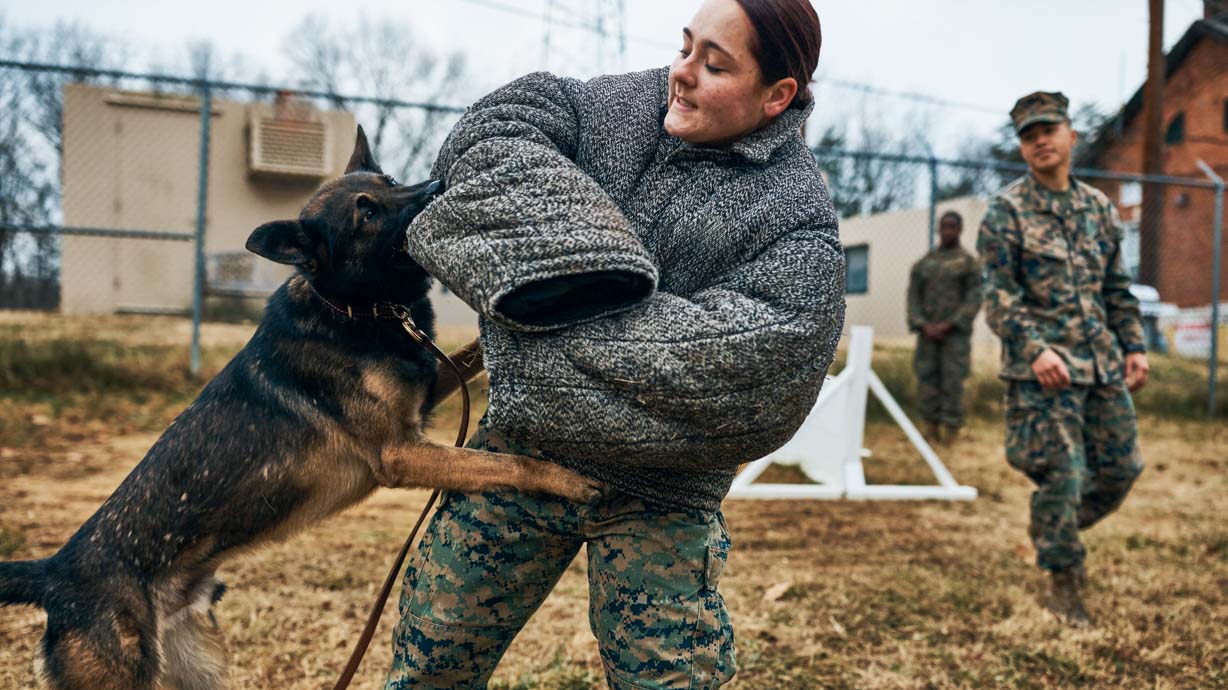
What do Military Dog Handlers do in the Military?
Where do Military Dog Handlers work?
Military dog handlers in the military work both indoors and outdoors depending on their assignment. They may work outdoors while conducting investigations or patrolling facilities.
How much do they make?
Median Military Salary
This is the median, or the midpoint, of the salary range for this career.
Note that the median salary does not include bonuses, special pays, health or dental benefits — which are a standard part of military compensation.
This is the median, or the midpoint, of the salary range for this career.
Note that the median salary does not include bonuses, special pays, health or dental benefits — which are a standard part of military compensation.
$67,527
Military Salary Range
This is the range based on years of service, degree level, special pays, family status and location.
Note that the median salary does not include bonuses, special pays, health or dental benefits — which are a standard part of military compensation.
This is the range based on years of service, degree level, special pays, family status and location.
Note that the median salary does not include bonuses, special pays, health or dental benefits — which are a standard part of military compensation.
$20,988 - $265,410
How Military Pay is More Than Just a Salary
Base pay is the standard income you'll earn as a service member, providing a stable foundation to start achieving your financial goals.
- Set based on rank and years of service.
- Paid every month.
Allowances are additional payments to help cover living expenses like housing and food.
- Tax-free payments.
- Varies by location and family status.
Special pay provides extra compensation for unique skills, hazardous duties, or challenging assignments.
- Based on specialized roles.
- Varies by position and duty.
Military working dog handler
Pfc. Brittany Gavit from the 2nd Military Working Dog Detachment at Fort Meade, Maryland, showcases the experience of a military working dog handler. Military working dogs, combined with their handlers, provide the Army with capabilities ordinary Soldiers cannot. Video by Sgt. Ross Mowery & Sgt. Angel Vasquez, Defense Media Activity-Army Media. #SoldierStory
Transcription
Pfc. Gavit: Military working dogs are not pets. My name is Pfc. Gavit. I'm a Military Working Dog Handler and my partner's name is Cody. When I arrived at Fort Meade, I got told I was going to get MW Cody. We started building rapport by spending mainly time with him in the first two weeks so he understands that I'm part of his family now - I'm his mom.
Then, as soon as I gained his trust and his respect that's when we started focusing on obedience and I told him what to do and we started working on issues that we had, but also on making our strengths better.
Cody's ability to smell is like most other dogs because he can intake different odors at the same time. He's able to directly go to the source or tell me where it is and respond to it and then we can find it together.
Military working dogs benefit the Army by being a psychological deterrent. They are able to detect odors that we as humans cannot and they have proven to be better than most machines and have had less failure rates.
Being a Military Working Dog Handler, it can be stressful at times and very physically demanding, but the camaraderie you'll have with the other handlers and the relationship to your dog beats all of it.
Military working dog handler
What training do Military Dog Handlers gain in the Military?
All enlisted service members complete basic military training, which includes time spent in a classroom and in the field, and covers tactical and survival skills, physical training, military life and customs, and weapons training. Military dog handlers will gain skills through classroom study and on-the-job experience. Job-specific training content may include:
- Military/civil laws and jurisdiction
- Investigation and evidence collection procedures and techniques
- Arrest and physical restraint techniques
- Self-defense and use of firearms
- Crime scene processing
- Interpersonal communications skills
- Search/restraint and custody/control procedures
- Crime prevention
- Specialized dog handling techniques
Military Training for Officers
Officers typically enter the Military after they have completed a four-year college degree. All officers complete a comprehensive training program covering responsibilities, military structure and etiquette, traditions, and leadership development.

What skills help Military Dog Handlers succeed?
- Ability to remain calm under pressure
- Interest in law enforcement and crime prevention
- Willingness to perform potentially dangerous work
- Ability to judge a situation accurately and react instantly
- Respect for dogs