









Explore Careers
Optometrists



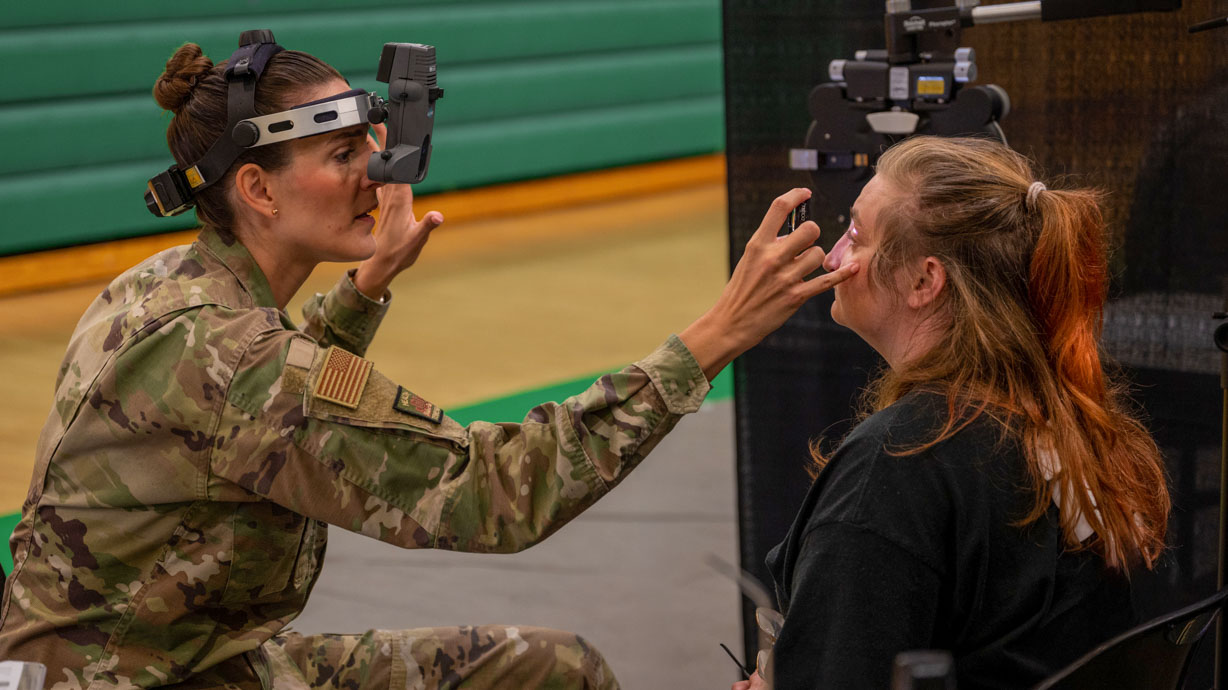
What do Optometrists do in the Military?
Where do Optometrists work?
Optometrists work in clinics and hospitals.
How much do they make?
Median Military Salary
This is the median, or the midpoint, of the salary range for this career.
Note that the median salary does not include bonuses, special pays, health or dental benefits — which are a standard part of military compensation.
This is the median, or the midpoint, of the salary range for this career.
Note that the median salary does not include bonuses, special pays, health or dental benefits — which are a standard part of military compensation.
$75,979
Military Salary Range
This is the range based on years of service, degree level, special pays, family status and location.
Note that the median salary does not include bonuses, special pays, health or dental benefits — which are a standard part of military compensation.
This is the range based on years of service, degree level, special pays, family status and location.
Note that the median salary does not include bonuses, special pays, health or dental benefits — which are a standard part of military compensation.
$24,656 - $358,842
How Military Pay is More Than Just a Salary
Base pay is the standard income you'll earn as a service member, providing a stable foundation to start achieving your financial goals.
- Set based on rank and years of service.
- Paid every month.
Allowances are additional payments to help cover living expenses like housing and food.
- Tax-free payments.
- Varies by location and family status.
Special pay provides extra compensation for unique skills, hazardous duties, or challenging assignments.
- Based on specialized roles.
- Varies by position and duty.
Army Optometry: Vision Beyond Limits
Explore an opportunity where advanced skills, global missions and service to others redefine what’s possible.
Transcription
HEINEN: In the Army, as an optometrist, it's similar to optometry in the civilian sector. However, we have the ability, unlike our civilian counterparts, to deploy operationally. We have a bit more capabilities that our civilian counterparts do and a bit more leeway as far as what we're able to do. Everything that we're taught is the same. Our education is the same as the civilian sector. However, because we are operational, we're able to do a bit more. So, the most interesting procedure for optometrists, specifically—because in a civilian practice, we are not authorized to do very much in terms of surgery, the surgeries will go for ophthalmologists— but in the Army we're able to do a procedure called a lateral canthotomy and a cantholysis. Where if a patient has fluid built up behind their eye—orbital compartment syndrome—we're able to release the tension around that eye and save that person's sight. That is something that a civilian optometrist is absolutely not able to do. They would get sued. But we're able to do that in the military because we're trained on that in the military. We're trained to treat ocular trauma. Optometrists go further downrange than our ophthalmology counterparts do. So, very often we are the first line of treatment for eyesight and sight-threatening issues. I knew that being a technician was really fun. I enjoyed helping people see better. And so I went to optometry school at Midwestern University in Phoenix, Arizona, and about halfway through optometry school, I realized how expensive optometry school was. And so I looked at other options apart from student loans. And I saw that the military offered what's called a Health Professions Scholarship Program (HPSP). And I was fortunate enough to receive a health professions scholarship from the Army. So, I thought, what the heck, let's try the Army. It was a three year return for service and they paid for the remainder of my college tuition. So, I was fortunate, again, enough to not have any student loans when I graduated optometry school. So, this is an ophthalmic technician program here at METC, Medical Education and Training Campus, where we take what amounts to be about a year worth of material. And we cram into eight weeks here. Our Soldiers will learn all of the pre-screening techniques that a technician requires to be in either an optometry office or an ophthalmology office. So, you learn how to meet and greet a patient. they learn rapport with the patient, pre-screening techniques. And then we have many machines that the technicians become proficient on, as well– when it comes to retinal photography and retinal imaging, contact lens, specialty contact lenses and diseases of the eye, as well. The technicians learn all forms of medications, ocular anatomy and physiology, and they are well-rounded and ready to provide care when they get to their first duty stations. I'm Cpt. Thomas Heinen, Be All You Can Be at GoArmy.com.
Army Optometry: Vision Beyond Limits
What training do Optometrists gain in the Military?
Officers typically enter the Military after they have completed a four-year college degree; enlisted service members can transition to officer positions through a variety of pathways and earn a degree while serving. Job training for optometrists primarily consists of classroom instruction and on-the-job learning in various training environments. Like other officers working in healthcare, they complete a comprehensive training program covering responsibilities, orientation to military structure, healthcare and etiquette, traditions, and leadership development.
Military Training for Enlisted Service members
All enlisted service members complete basic military training, which includes time spent in a classroom and in the field, and covers tactical and survival skills, physical training, military life and customs, and weapons training.

What skills help Optometrists succeed?
- Desire to help others
- Interest in work requiring accuracy and attention to detail
- Preference for working closely with people
What are possible career paths after the Military?
- Ophthalmic Medical Technologists
- Opticians, Dispensing
- Ophthalmic Medical Technicians
- Orthoptists
- Ophthalmologists, Except Pediatric
- Optometrists