









Explore Careers
Electrical and Electronics Engineers
Explore Careers
Electrical and Electronics Engineers
Science, Technology, Engineering & MathematicsService Branches with this Role




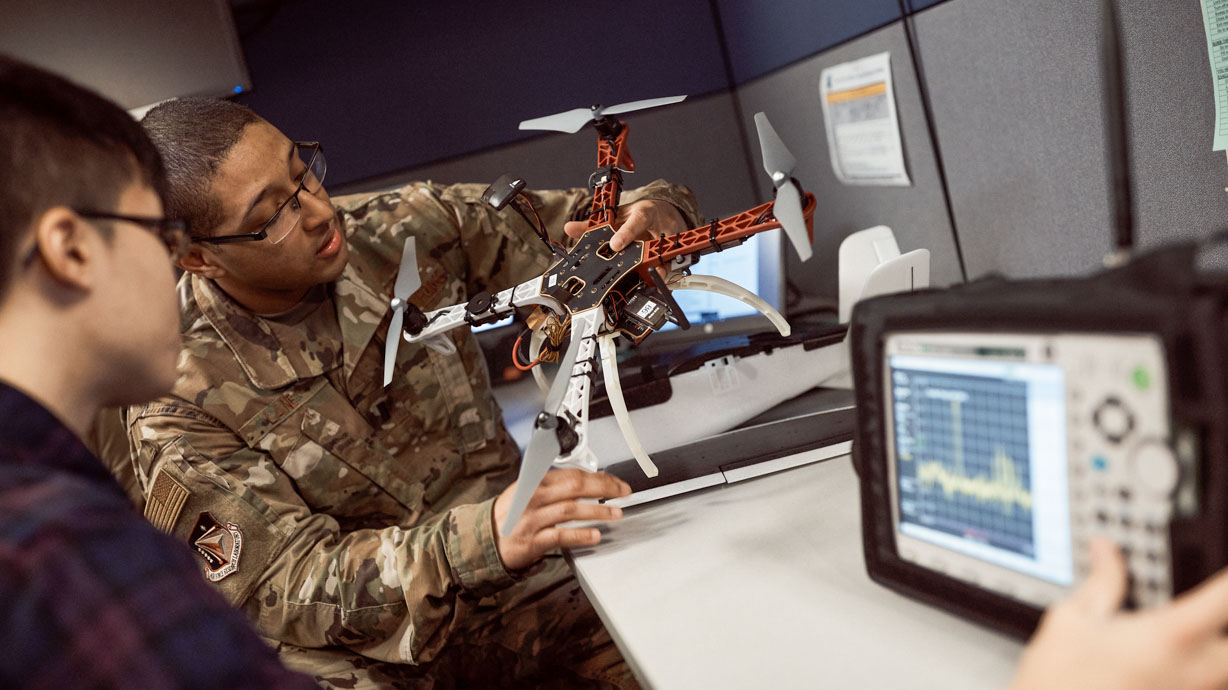
What do Electrical and Electronics Engineers do in the Military?
Where do Electrical and Electronics Engineers work?
Electrical and electronics engineers usually work in offices while planning research studies and designing electronic systems. They may work outdoors when overseeing the installation of new equipment.
How much do they make?
Median Military Salary
This is the median, or the midpoint, of the salary range for this career.
Note that the median salary does not include bonuses, special pays, health or dental benefits — which are a standard part of military compensation.
This is the median, or the midpoint, of the salary range for this career.
Note that the median salary does not include bonuses, special pays, health or dental benefits — which are a standard part of military compensation.
$91,234
Military Salary Range
This is the range based on years of service, degree level, special pays, family status and location.
Note that the median salary does not include bonuses, special pays, health or dental benefits — which are a standard part of military compensation.
This is the range based on years of service, degree level, special pays, family status and location.
Note that the median salary does not include bonuses, special pays, health or dental benefits — which are a standard part of military compensation.
$23,152 - $356,274
How Military Pay is More Than Just a Salary
Base pay is the standard income you'll earn as a service member, providing a stable foundation to start achieving your financial goals.
- Set based on rank and years of service.
- Paid every month.
Allowances are additional payments to help cover living expenses like housing and food.
- Tax-free payments.
- Varies by location and family status.
Special pay provides extra compensation for unique skills, hazardous duties, or challenging assignments.
- Based on specialized roles.
- Varies by position and duty.
Transcription
One of the first things I did as an electrical engineering student when I graduated from college was I designed an EKG monitor. A year later I was in the hospital and I looked up and I saw, sure enough on the operating table, there was my monitor being used. And, I told the surgeon you know I designed that monitor. I can fix it if it breaks down and he said, "shut up I'm gonna put you out." So that was that; was something that I got to see that I designed myself.
When I think about electrical engineering. I think about everything that's happening in the world today. So technology is advancing at rates that we've never seen before and the things that you can do with computers and technology nowadays you could never do before. And what I think of that I think of Electrical Engineering.
Dual tracking for electrical engineering and so you get the cyber side you get the network security you get some of the software side. And I also have the system such as communication systems. So cyber is a very important part of the Coast Guard it's common of the Coast Guard's one of his main directives.
So cyber is really being ingrained across all majors here at the Coast Guard Academy but most particularly in electrical engineering. We're not really new to cyber. When I was the cadet I participated in the cyber defense exercise sponsored by the NSA in 2006, but now is really an exciting time to get involved with cyber at the Coast Guard Academy. The Commandant's cyber strategy that was just released calls for having a cyber aware Coast Guard workforce and for many of the officers in the Coast Guard that will start right here at the Coast Guard Academy when your academic.
My following job after grad school was supporting the mobile contingency communication systems and those are used in response action. So of course search operations natural disasters. Anytime that effect error goes down and they need to restore it but the building for whatever reason they take the power stability or something like that. These vehicles deploy with operators you can set up and have internet co-starred internet and dirty Internet they can have all of the communication capability at sector weather radio communication.
You use technology to do anything, whether it's applications on your phone or whether it's video messaging. Everything like that has to be programmed by an electrical engineer and I think the idea that I can be in that small group of people who know how to make the world a better place using technology. I think that for me is the biggest change that I want to see and that I know as electrical engineer I can help make that happen.
Inside Academics: Electrical Engineering
What training do Electrical and Electronics Engineers gain in the Military?
Officers typically enter the Military after they have completed a four-year college degree; enlisted service members can transition to officer positions through a variety of pathways and earn a degree while serving. Electrical and electronics engineers typically have a degree in engineering. Job training for electrical and electronics engineers primarily consists of on-the-job learning in various training environments. Like other officers, they complete a comprehensive training program covering responsibilities, military structure and etiquette, traditions, and leadership development. Job-specific training content may include:
- Combat and tactical systems and networks
- Weapon system electronics
Military Training for Officers
Officers typically enter the Military after they have completed a four-year college degree. All officers complete a comprehensive training program covering responsibilities, military structure and etiquette, traditions, and leadership development.

What skills help Electrical and Electronics Engineers succeed?
- Interest in engineering concepts and principles
- Interest in planning and directing research projects
- Interest in working with mathematical formulas